
Beloved brothers and sisters in Christ,
The story of Zacchaeus is one of the most tender and hopeful encounters in the Gospel. It shows us not only who Christ is, but who we can become when we truly desire to see Him.
Zacchaeus was a man who had everything by the world’s standards. He was wealthy, powerful, and feared. Yet inside, he was small, not only in stature, but in spirit. The Gospel tells us he wanted to see Jesus, but he could not, because of the crowd and because he was short. This is already a picture of the human condition. We want God, we long for meaning, peace, and healing, but so often something stands in the way. The crowd may be our sins, our shame, our past, our pride, or simply the noise and busyness of life. And like Zacchaeus, we feel too small, too unworthy, or too far gone to push through.
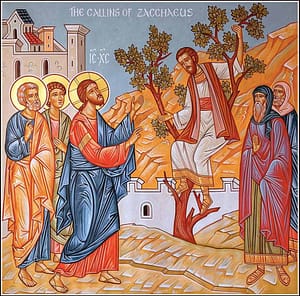
But Zacchaeus does something very simple and very courageous. He runs ahead and climbs a tree. For a grown man, a wealthy official, this was undignified and even ridiculous. Yet this is the beginning of repentance. Repentance always involves humility. It means accepting that we cannot stay where we are if we want to see Christ. Zacchaeus risks embarrassment in order to gain a glimpse of Jesus. He teaches us that spiritual growth begins when we stop worrying about how we look and start caring about where our heart is.
And then something extraordinary happens. Zacchaeus wants to see Jesus, but in truth, it is Jesus who has been looking for Zacchaeus all along. Christ stops, looks up, and calls him by name. He does not rebuke him. He does not list his sins. He simply says, “Zacchaeus, make haste and come down, for today I must stay at your house.” This is the Gospel in one sentence. God takes the initiative. Salvation is not a reward for the righteous, but a gift offered to those who are willing to receive Him. Christ enters the house of a sinner, not because the sinner is perfect, but because the sinner is open.
The crowd murmurs and judges. They always do. They see Zacchaeus as he was, not as he is becoming. But Christ sees the heart. When Christ enters Zacchaeus’s home, He also enters his life. Notice that Jesus does not demand change first. The change comes naturally as a response to love. Zacchaeus stands and says, “Behold, Lord, half of my goods I give to the poor, and if I have taken anything from anyone by false accusation, I restore fourfold.” This is not forced repentance. It is joyful repentance. It is the fruit of an encounter with mercy.
Here we learn something deeply practical for our own lives. True repentance is not merely feeling bad about our sins. It is a reorientation of the heart. Zacchaeus does not just say sorry. He acts. He repairs what was broken. He becomes generous where he was greedy, just where he was unjust. Real conversion always shows itself in concrete ways: in how we treat people, in how we use our money, our time, our words, and our power.
And then Christ speaks words that are full of hope for every one of us: “Today salvation has come to this house, because he also is a son of Abraham. For the Son of Man has come to seek and to save that which was lost.” Zacchaeus is restored not only to God, but to the community. He is no longer defined by his past. He is defined by his relationship with Christ.
Beloved brothers and sisters, Zacchaeus is each one of us. We are all short in some way. We all struggle to see clearly. We all carry sins and wounds that make us hide or keep our distance. But the Gospel assures us that Christ passes by our lives every day. The question is not whether Christ is willing to enter our house, but whether we are willing to climb the tree, to step out of our comfort, and to let Him in.
Practically, this means making small but real movements toward Christ. It may mean setting aside time for prayer when life feels too busy. It may mean going to confession honestly and without excuses. It may mean forgiving someone, giving generously, or correcting an injustice we have ignored. These are our trees. They may feel uncomfortable or humiliating, but they open our eyes to Christ.
Do not be afraid of being seen as small. Humility is the ladder by which Christ comes to us. And when He comes, He does not come to shame us, but to heal us. He comes not to visit for a moment, but to dwell in our hearts.
May we, like Zacchaeus, desire to see Jesus. May we run ahead of our excuses, climb above our fears, and welcome Christ into the house of our soul. And may we hear those same words spoken over our lives: Today salvation has come to this house.